
Fashion photography is much more than beautiful images: it is a strategic tool for brand positioning and branding. Right from the first line, we need to emphasize that both commercial and editorial photography are visual languages that shape public perception and directly influence the success of a fashion campaign.
In this article, we will deeply analyze the differences, functions, and impacts of each approach, bringing fresh insights so your brand can achieve digital and emotional relevance.
Commercial photography is born with a clear objective: to sell. In general terms, it consists of images created to promote products, services, or reinforce a company’s identity. As explained by Format, this type of photography is directly linked to revenue growth and business strategy support.
In other words, when we think of commercial photography, we think of catalogs, e-commerce, paid ads, and campaigns that need to be direct, persuasive, and conversion-oriented. In this context, choosing the right professional is essential — and we have already explored this topic in detail in the article “How to Hire the Ideal Fashion Photographer for Your Brand”, which shows how to align technique and creative vision with commercial needs.
The logic is simple: every detail of the image is designed to highlight the product. Lighting, framing, and even the setting are planned to eliminate distractions and guide the consumer’s eye to the main item.
We know that, in this context, aesthetics are not just about beauty but functionality. Commercial photography is pragmatic, objective, and results-driven.
– Strengthen branding: by creating visual consistency, the brand becomes recognizable.
– Boost fashion campaigns: commercial images are essential in digital and print ads.
– Increase conversion: well-produced photos reduce doubts and encourage purchase.
Traditionally, editorial photography is linked to publications. According to Adobe, it consists of images that may accompany articles or exist independently, always with a narrative or creative concept.
Here, the focus is not on selling directly but on building a story that engages the audience. Editorial photography is art, concept, and emotion. It translates values, inspires, and connects. To better understand how this process develops within brands, we recommend the article “How the Fashion Editorial Creation Process Works for Brands”, which details fundamental creative steps and decisions.
– Build brand positioning: editorials reinforce the company’s identity and values.
– Generate desire: by creating aspirational atmospheres, the brand becomes an object of admiration.
– Inspire campaigns: editorials are often used as creative bases for collections and launches.
The choice depends on the brand’s objective. If immediate conversion is the goal, commercial photography is indispensable. If the aim is to build a long-term narrative and reinforce values, editorial is the way.
In practice, the ideal is to combine both approaches. A fashion campaign can be born from an inspiring editorial and unfold into commercial images that sustain sales.
Although often confused, a fashion campaign is a broad project that may include both commercial and editorial images. Commercial photography is only one part of this ecosystem.
The campaign involves strategy, distribution channels, storytelling, and impact metrics. Commercial photography, on the other hand, is the visual execution aimed at conversion.
– Commercial photography: recommended for product launches, catalogs, and e-commerce.
– Editorial photography: ideal for reinforcing branding, creating desire, and positioning the brand in the collective imagination.
We believe the true power lies in integration. Editorial builds the brand’s aura, while commercial transforms that aura into sales. Together, they create consistency, relevance, and impact.
A practical example: a brand can launch a conceptual editorial that translates its values and then use commercial images derived from that concept to sell the collection. This synergy strengthens brand positioning and generates tangible results.
Requesting a photographic production requires clarity of objectives and understanding of the differences between the two styles. Each choice directly impacts branding and brand positioning. See the key points:
– Product clarity: the product must be the absolute protagonist.
– Visual consistency: aesthetic alignment with the brand’s branding.
– Channel suitability: e-commerce photos require neutral backgrounds; ads can be more creative.
– Conversion: images function as visual sales arguments.
– Right professional: choosing the right photographer is decisive.
– Brand narrative: telling a story that reflects values and identity.
– Creative concept: requires strong artistic direction.
– Emotional impact: creating aspirational connection with the audience.
– Versatility: use in magazines, social media, and campaigns.
– Structured process: understanding creative steps and decisions.
– Review objectives: move beyond exclusive sales focus.
– Art direction: invest in visual narrative.
– Continuity: ensure dialogue between styles.
– Simplify narrative: transform concepts into objective images.
– Maintain identity: preserve brand essence.
– Product focus: absolute protagonism of the item.
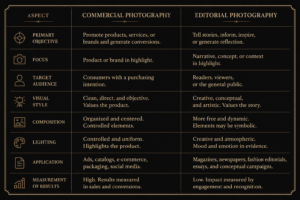
The choice between commercial and editorial photography should not be seen as mutually exclusive. Each style fulfills an essential role: selling and, at the same time, building meaning.
If your brand wants to grow, achieve relevance, and connect emotionally with the audience, integrating these two languages is a strategic and powerful path.
Reflect on how photography can support your brand’s objectives. By aligning commercial impact with the narrative strength of editorial, you open space for more consistent and memorable campaigns.
*photography *fashion *editorials *campaigns *branding *flyhigh *clycz